
Sayacmarca: The Inaccessible Town Overlooking the Inca Trail
Shortly after crossing the Runkurakay pass, a narrow, steep stone staircase leads the Inca Trail 4 days up to one of its most photogenic sites: Sayacmarca, a citadel built right at the edge of a cliff that, just as its name suggests, seems deliberately designed to be hard to reach.
What Does Sayacmarca Mean?
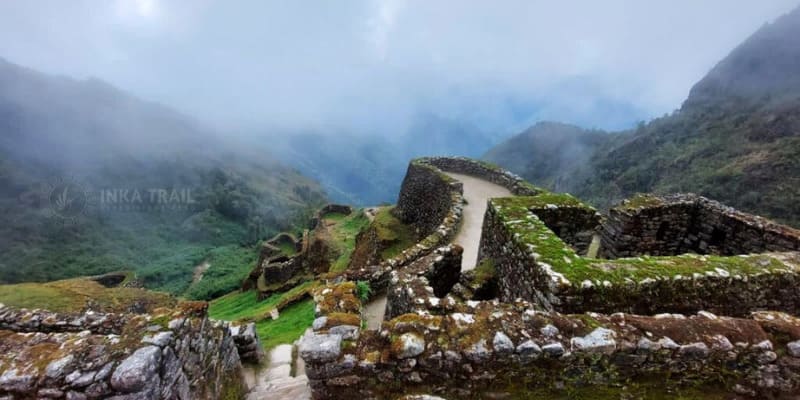
The name Sayacmarca comes from two Quechua words: "sayac," meaning "standing tall" or "upright," and "marca," translated as "place" or "town." The combination is often interpreted as "standing town," though the site is also widely known as the "inaccessible town" or "dominant town" — names that accurately describe its location: perched on a mountain ridge, right at the edge of a cliff, visible yet hard to reach.
That isolated character is no accident. Sayacmarca is believed to have served control and watch functions within the Qhapaq Ñan network, taking advantage of its elevated position to monitor the flow of travelers along this stretch of the route. Its location also gave it natural protection, leading some researchers to also consider it a structure with a degree of defensive value.
A Citadel Built in Three Sectors
Sayacmarca is organized into three main sectors: a tower, a residential dwelling area, and a set of ceremonial baths known as the "Inca baths." These sectors are connected by staircases and narrow passageways, all distributed across different levels that adapt to the mountain's rugged terrain.
The site also features a sophisticated water channel system running through much of the complex, evidence of the hydraulic mastery that characterized Inca engineering. Sturdy retaining walls support the structures on the cliffside, allowing the citadel to stand firm despite its extreme location.
An Engineering Detail: Two Types of Stone
One of the most striking aspects of Sayacmarca is the combination of materials used in its construction: alongside local rock, the Incas used granite transported from a quarry located more than 30 kilometers away. This detail reveals the extraordinarily high logistical and technical capacity reached by the Inca Empire, able to move heavy materials across mountainous terrain to raise constructions of this caliber in remote locations.
Rediscovered by the Same Explorer as Machu Picchu
Sayacmarca was rediscovered in the early 20th century by Hiram Bingham, the same American explorer who brought Machu Picchu to the world's attention in 1911. This connects Sayacmarca directly to the history of modern exploration in the region, and explains why, despite being a smaller site, it forms part of the broader archaeological study of the Machu Picchu Historic Sanctuary.
Why This Stop Stands Out
It isn't the largest complex on the Inca Trail, but few structures convey such a clear sense of control as Sayacmarca. Even today, the approach feels deliberate, protected, and somewhat defensive: climbing its narrow stone staircase and reaching the top, with panoramic views over the surrounding valleys and mountains, is one of the most memorable experiences of Day 3.
Location and How to Get There
Sayacmarca sits in the Cusco region, on a mountain ridge, about 19–20 km from the start of the classic Inca Trail, near the Chaquicocha campsite. There's no vehicle access: it can only be visited on foot, climbing a stone staircase after leaving the Runkurakay pass behind, during the third day of the trek.
Reference location of Sayacmarca, classic Inca Trail, Cusco.
Other Stops Near Sayacmarca
Runkurakay
The circular site and mountain pass crossed just before reaching Sayacmarca.
Phuyupatamarca
The "town above the clouds", the next major landmark of Day 3, with its ceremonial fountains.
Wiñaywayna
The last campsite before Machu Picchu, next to one of the most impressive archaeological sites on the route.
Climb Up to Sayacmarca on Your 4-Day Inca Trail Trek
Sayacmarca is one of the most photogenic stops on the most archaeology-rich day of the Inca Trail. Check out the full itinerary, available dates, and everything included in our classic Inca Trail tour.